
Most Advisors Invest Their Client’s Portfolios Incorrectly
Their process goes something like this – they have their client complete a short questionnaire and assign them a “risk tolerance”. The results of this questionnaire are then used to determine the client’s asset allocation and their portfolio is invested accordingly, oftentimes in a mix that the advisor doesn’t even manage and is riddled with additional fees that don't get disclosed.
At no point is asset location taken into consideration, and under no circumstances does the advisor deviate from the client’s assigned mix.
It’s embarrassing how common it is in my industry. Today, I’m going to share exactly how we design every client portfolio, the reasons behind our method, and how client portfolios can be expected to change throughout their retirement.
Step 1: Determine Asset Allocation
Designing a portfolio requires answering a few key questions.
First, you have to determine the proper asset allocation – the breakdown between growth assets (typically stocks) and conservative assets (typically bonds and cash) to be held across a portfolio. Second, you have to decide where each type of investment belongs across your various accounts (which is called asset location).
For determining asset allocation, my framework is as follows – keep five years’ worth of anticipated portfolio distributions in conservative assets like the money market and bonds (I call this your "reserves"). The rest of your assets are invested in a diversified mix of equities.
This way, when (not if) the stock market crashes, we have five years of distributions set aside – enough to ride out most of the nastiest bear markets in history. There’s a lot more behind why five years is the optimal reserve balance, but we’ll have to save that for another day. For now, just know that it’s risk-optimal, meaning that by having more or less than five years in conservative assets, you’re likely taking more risk than you need to.
It’s not as simple as taking your annual distributions, multiplying by five, and rebalancing your portfolio, however. Recall that your investments are paying income while you hold them in the form of dividends and interest. This income also must be considered and can offset the amount that’s being held in conservative assets.
Let’s look at an example to see how this actually plays out.
Michael and Holly Scott are retiring in 2 years and their anticipated retirement expenses in early retirement look like this:

They’ll have social security, but it won’t begin for a while so all of these expenses will need to be funded through portfolio distributions.
Finally, we need to take their other goals - which I call short-term cash needs – and include them as well. Michael and Holly have the following short-term cash needs:
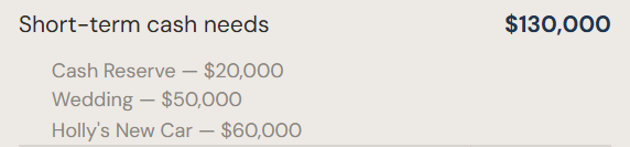
After adjusting for inflation, their next five years’ worth of portfolio distributions can be calculated as follows:

Let’s assume the expected annual income from their accounts and their balances are:

After adjusting for inflation, we get a total anticipated portfolio income amount of $264,000 being paid over the next five years.
Again – it would be a mistake to stop here. Stock dividends tend to grow every year which means the number we’ve calculated above is too conservative. On the other hand, we’re also expecting Michael and Holly to take distributions from their portfolio, which means we can’t count on all of that income being received by them (because some of the assets that would have paid them out would have been sold and distributed).
To account for these factors, I take multiple variables into account and weigh all of them to come up with a total “score” that I use to adjust their expected income over the five-year window in question.
Netting their total gross distribution need against their anticipated portfolio income, we get a reserves target of $538,000, which is 16% of their total portfolio, leaving the other 84% for investment in growth assets.


Step 2: Determine Asset Location
We have our asset allocation figured out, but there are still outstanding questions that must be answered before we can invest/rebalance Michael and Holly’s portfolio. They have multiple types of accounts, all of which are taxed in different ways and are therefore more/less optimal for various types of investments.
In their pre-tax accounts, all growth and interest is tax-deferred but distributions are fully taxable. They’ll also be subject to required minimum distributions (RMDs) later in their lives so higher balances in these accounts means higher taxes later on. If we need to hold assets with high anticipated rates of long-term growth, therefore, this should be our last option. On the other hand, it’s a great place for our conservative investments.
Their Roth accounts, however, are just the opposite. While growth and interest are still tax-deferred, distributions are tax-free and there are no RMDs making these the first place we’d elect to hold growth assets.
Taxable accounts are closer to Roth accounts than pre-tax accounts on the tax-favorability spectrum making them a great place (although secondary to Roth) to hold growth assets. They're also typically the first place we’ll take distributions from in retirement, which means we need at least some reserves here even if it’s not tax-optimal – usually 1-2 years’ worth.
Finally, we need to take their ages into account. In general, we want to prioritize holding reserves in the older spouse’s accounts because will be the first to face RMDs.
When we take these facts into consideration, we need to hold Michael and Holly’s reserves in Michael’s 401(k) and, since that account is large enough to hold all of their reserves, that’s where they’ll go! The rest of their accounts will be invested in 100% growth for now.

Adjust Over Time
The final step is to reiterate this process every year and adjust as your distribution needs change.
For example, when you turn 65 and start Medicare, your health care costs typically come down considerably. When you begin Social Security, that income will offset a lot of the distribution need from your portfolio as well. Taken together, the perfect retirement portfolio will typically become more aggressive over time – the exact opposite of conventional wisdom and what most advisors will recommend.
If you’ve never had a portfolio design process like this, reach out and apply to work with us! This is only one step in our comprehensive financial planning process which is designed to make sure that you get clear and comprehensive answers to the most important questions you can ask when you’re planning your retirement.


